



Learning from BCI July 2026 Circular
By: Muhammad Shafique Baloch, Advocate High Court
Facing this legal problem? Talk to an Advocate High Court today.
Muhammad Shafique Baloch, Advocate High Court, Lahore. Practising since 2006 in bail, FIA, family, property and writ matters. | ابھی واٹس ایپ پر رابطہ کریں
Date: July 18, 2026
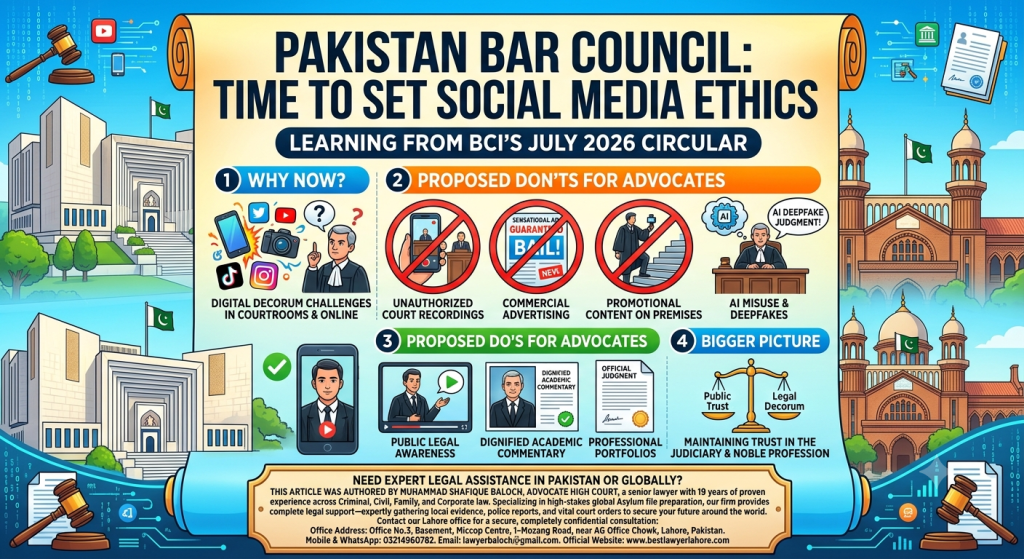
The legal profession in Pakistan is at a critical turning point. With TikTok, YouTube Shorts, Instagram Reels, and advanced AI tools in virtually every lawyer’s pocket, the administration of justice is no longer confined to the physical walls of a courtroom. While digital platforms offer unprecedented reach for legitimate public legal education, they also present a rapidly growing challenge to the dignity, decorum, and long-standing ethics of our noble profession.Just yesterday, on July 17, 2026, the Bar Council of India (BCI) issued a landmark, comprehensive 37-page circular strictly regulating how advocates, law students, interns, and legal educators utilize social media networks. It is high time that the Pakistan Bar Council (PBC) and our respective Provincial Bar Councils introduce similar binding guidelines to protect the integrity of our courts and the sanctity of the legal profession.What Did the BCI Circular Direct?The BCI took formal notice of a growing and deeply disturbing tendency among certain legal practitioners and law students to create sensational reels, edit dramatic clips of live-streamed court proceedings, and leverage AI-generated content for aggressive commercial gains.The core prohibitions introduced in their historic circular include:
No Courtroom Recording or Clips: A strict prohibition on the unauthorized video recording of court proceedings and the circulation of edited, out-of-context clips from official judicial live-streams.
No Unethical Solicitation: A blanket ban on social media posts claiming guaranteed outcomes, success rates, clickbait titles, or comparative superiority over fellow advocates.
No Promotional Content on Premises: Legal practitioners are barred from shooting reels or promotional videos inside court premises, corridors, bar rooms, or using official gowns and robes for digital personal branding.
No AI Misuse: Strict disciplinary action against the deployment of deepfakes, voice cloning, fabricated judgments, fake citations, and the digital impersonation of judges or fellow lawyers.
No Client Data Breaches: Explicitly prohibiting the online publication of confidential client details, privileged communications, or unverified testimonials.
Mandatory Student Undertakings: Law students must sign formal, binding undertakings before university admission and internships, pledging to maintain strict confidentiality and abstain from recording court proceedings.As the circular rightly reminded the fraternity, the legal profession is first and foremost a public service, not an ordinary commercial marketplace.Why Pakistan Needs Similar Rules Immediately Walk into the Lahore High Court, the Sindh High Court, or any District Court across Pakistan, and the digital spillover is impossible to ignore. It is becoming increasingly common to witness online behavior that blurs the line between professional advocacy and entertainment:
Lawyers publishing lifestyle reels or dynamic daily vlogs using active case files and court halls as personal backdrops.
Edited short-form clips of aggressive cross-examinations or tense dialogues with judges, complete with dramatic background music and mocking captions.
Sensational online advertisements promising guaranteed bail or instant divorce remedies.
AI-generated summaries of unverified or outright fabricated case laws circulating rapidly within professional WhatsApp groups.
Live interviews and strategic updates filmed right outside courtroom doors solely for instant social media clout.This unchecked digital behavior carries severe consequences for the legal framework:
It erodes public trust in the solemnity, neutrality, and ultimate authority of the judiciary.
It directly threatens strict client confidentiality, which is protected under our existing code of conduct.
It turns legal advocacy into commercial advertising, an activity that our traditional professional codes have strictly prohibited for generations.
Proposed Digital Framework for the Pakistan Bar CouncilTo address these modern challenges, the Pakistan Bar Council should issue a formal circular and formally amend Chapter II, Part VI of the Legal Practitioners and Bar Councils Rules, 1976. A clear, enforceable set of digital rules will protect younger practitioners while establishing firm ethical boundaries.
The Don’ts for Advocates:
Zero Unauthorized Recording: Absolute prohibition on recording or broadcasting physical, virtual, or hybrid court proceedings without explicit, formal judicial permission. *
Preserve the Gown: No creation of promotional, commercial, or entertainment content inside court premises, bar rooms, or while actively wearing professional bands and black gowns.
No Commercial Solicitation: A firm ban on digital marketing campaigns featuring arbitrary success rates, guaranteed results, or sensationalist thumbnails.
Strict Confidentiality: Absolutely no sharing of client names, case files, or privileged legal communications to drive online engagement.
Guard Against AI Abuse: Zero tolerance for sharing AI-generated fake citations, deepfakes, or automated legal advice masquerading as definitive statutory law.The Do’s for Advocates:
Public Legal Awareness: Utilizing digital platforms strictly to educate the general public on fundamental rights, statutory laws, and institutional procedures.
Academic Commentary: Sharing objective, dignified commentary on landmark judgments after they are officially reported, devoid of personal attacks or sensationalism.
Dignified Professional Profiles: Maintaining online portfolios and professional networking profiles in a manner completely consistent with the sobriety of the Bar.For Law Students and Interns:Every LLB and LLM student in Pakistan should be required to sign a standardized ethical undertaking at the time of university admission and prior to commencing any chamber internship. This undertaking would legally bind them to maintain strict confidentiality, respect court decorum, and completely abstain from unauthorized filming. Law colleges and universities must be held strictly accountable for maintaining these records.
The Path ForwardOur neighbors took this massive step because unchecked social media behavior was actively diminishing public confidence in the administration of justice. Pakistan’s legal ecosystem faces the exact same structural challenge today.Our Canons of Professional Conduct already explicitly prohibit touting, soliciting, and advertising. The Pakistan Bar Council simply needs to formally extend these timeless principles to cover digital platforms, reels, shorts, AI-generated content, and live-streams. A modern profession requires modern regulations. If we do not act swiftly, we risk allowing our rich courtrooms and legal heritage to be reduced to mere social media entertainment.
Need Expert Legal Assistance in Pakistan or Globally?
This article was authored by Muhammad Shafique Baloch, Advocate High Court, a senior lawyer with 19 years of proven experience across Criminal, Civil, Family, and Corporate law.Specializing in high-stakes global Asylum file preparation, our firm provides complete legal support—expertly gathering local evidence, police reports, and vital court orders to secure your future around the world.Contact our Lahore office for a secure, completely confidential consultation:Office Address: Office No.3, Basement, Miccop Centre, 1-Mozang Road, near AG Office Chowk, Lahore, PakistanMobile and WhatsApp: 03214960782Email: lawyerbaloch@gmail.comOfficial Website: www.bestlawyerlahore.com