








By Muhammad Shafique Baloch, Advocate High Court, Lahore
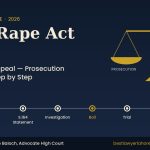
A rape case in Pakistan is no longer run purely under the ordinary Code of Criminal Procedure. Since the Anti-Rape (Investigation and Trial) Act, 2021 (Act No. XXX of 2021) came into force, a rape or sexual-abuse case involving a woman or a child moves through a special track: Anti-Rape Crisis Cells, Special Sexual Offences Investigation Units (SSOIUs), Special Courts, in-camera trials, a one-time video-recorded statement under section 164 Cr.P.C., and an appeal to a Division Bench of the High Court within 30 days.
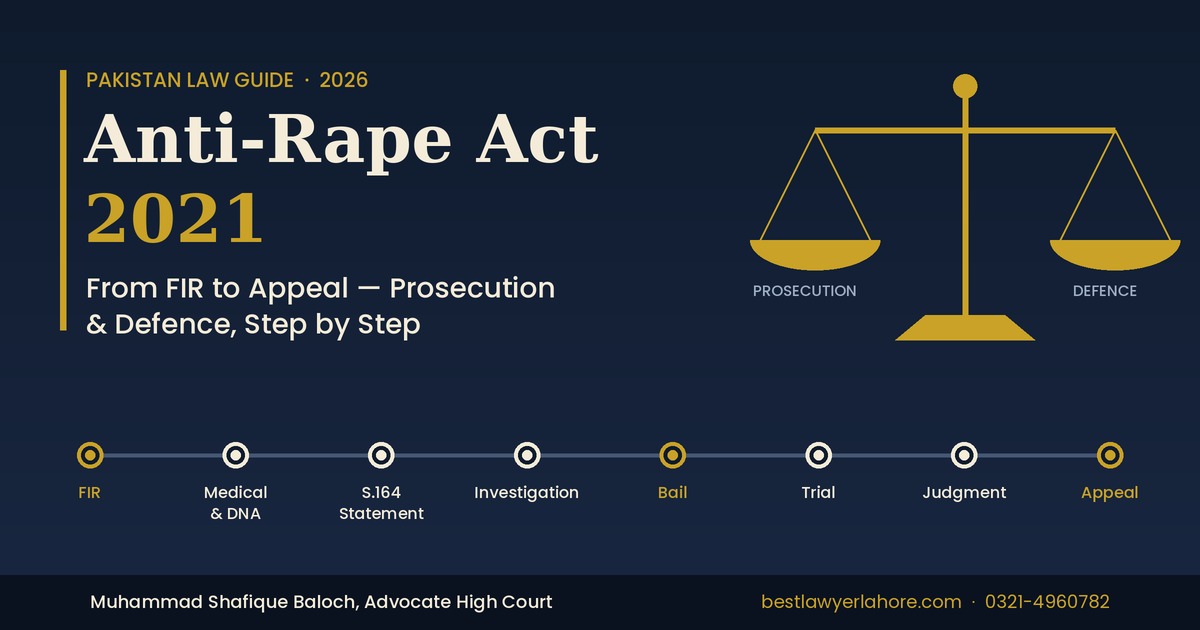
This guide walks through every stage — FIR, medical examination and DNA, the section 164 statement, investigation, bail, trial, judgment and appeal — and at each stage sets out what the prosecution / complainant must do and what the defence should watch for. It is written for victims and their families, for persons accused, and for fellow members of the Bar.
1. What the Anti-Rape Act 2021 Covers
The Act received assent on 1 December 2021 and extends to the whole of Pakistan. Its stated object is the expeditious redressal of rape and sexual-abuse crimes against women and children through special investigation units and Special Courts.
- “Victim” means a woman or a child subjected to a scheduled offence; a “child” is any male or female under 18 (section 2).
- Where the person aggrieved is not a woman or a child (for example, an adult male), the Explanation to section 2 says the case is tried under the ordinary procedure, rules of evidence and courts — not under this Act. This is the first point any counsel should check.
- Schedule-II (the core rape schedule) includes sections 336-A, 336-B, 354-A, 365-B, 366-A, 366-B, 367-A, 371-A, 371-B, 375, 375-A, 376, 377, 377-A, 377-B PPC, with connected offences (sections 34, 364, 364-A, 511 PPC, Chapters V, V-A and XVI PPC and the ATA, 1997) only where linked to these offences.
- Schedule-I covers sections 292-A to 292-C and 354 PPC, sections 21 and 22 of PECA 2016, and connected offences.
- Scheduled offences are exclusively triable by the Special Court (section 23), and for Schedule-II offences the Act has overriding effect over any inconsistent law (section 28). The Cr.P.C. applies only to the extent it is not inconsistent (section 29).
The substantive offence and punishment still come from the Pakistan Penal Code: rape is defined in section 375 PPC and punished under section 376 PPC (death or imprisonment of not less than ten and not more than twenty-five years with fine; gang rape, and rape of a minor or a person with a mental or physical disability, attract death or imprisonment for life).
2. Stage One — Reporting and the FIR
The statutory scheme
- Anti-Rape Crisis Cells (ARCCs) are set up in public hospitals, headed by the Commissioner or Deputy Commissioner, with the hospital’s Medical Superintendent and a police officer (section 4). On receiving information of a Schedule-II offence from any source, the ARCC must ensure, without delay, the medico-legal examination, collection of evidence, forensic analysis and registration of the FIR (section 5).
- Any SHO who receives information of such an offence must pass it to the ARCC immediately.
- Under the Anti-Rape (Investigation) Rules (notified by S.R.O. 185(I)/2023), the officer-in-charge of the SSOIU must ensure the FIR is registered immediately; a lady police officer, where appointed, is to be called; and the victim’s statement is recorded in private, with a person of her choice present, and only with her prior consent (Rules 3 and 4).
- Under section 21, a police officer who learns of a scheduled offence, or a threat of one, must act immediately — even outside his own jurisdiction.
For the prosecution / complainant
- Report as early as possible and insist on the ARCC route; the FIR should record time, place, the accused’s identity and any witnesses who saw the victim immediately after the incident.
- If police refuse to register the FIR, file an application under section 22-A/22-B Cr.P.C. before the Ex-officio Justice of Peace (Sessions Judge), and complain to the SSOIU head and the ARCC.
- Delay is not automatically fatal. Superior courts have repeatedly recognised that shame, fear, family pressure and trauma explain delay in sexual-offence cases. Even so, the reasons for any delay should be stated in the FIR itself, not invented later.
- Preserve clothing, bedding, phones, chats and CCTV — hand them over against a recovery memo.
For the defence
- Unexplained delay remains a live argument. In Muhammad Imran v. The State (2024 SCP 226) and Hassan Khan v. The State (2025 SCP 461), majority benches of the Supreme Court converted rape convictions into the lesser offence of fornication, relying heavily on delay in the FIR and the absence of marks of resistance — both judgments drew strong dissents and academic criticism, so use them carefully.
- Compare the FIR with the first written complaint, the ARCC entry and the MLC timing for inconsistencies in time, place and number of accused.
- Check whether the case was in fact registered and investigated by the SSOIU. The Sindh High Court has treated non-compliance with section 9 as more than a formality when considering bail.
- Where the complaint is false, section 22(2) of the Act makes giving false information about a scheduled offence punishable with up to three years and fine — a legitimate response, but only where the record supports it.
3. Stage Two — Medical Examination and DNA
The law
- Section 164-A Cr.P.C. provides for medical examination of the rape victim (with her consent) and section 164-B Cr.P.C. requires DNA samples to be collected, where practicable, and sent for analysis.
- Section 13(1) of the Act strictly prohibits the two-finger virginity test and gives it no probative value. The Lahore High Court had already declared the two-finger and hymen tests illegal and unconstitutional in Sadaf Aziz v. Federation of Pakistan (W.P. No. 13537/2020, decided 04.01.2021, per Ayesha A. Malik, J.).
- Rules 6 to 8 of the Investigation Rules require scene sealing, proper packaging, marking and an unbroken chain of custody for every sample.
- The Supreme Court in Salman Akram Raja v. Government of Punjab (2013 SCMR 203) issued binding guidelines for rape investigations, including prompt DNA sampling and early recording of the victim’s statement before a Magistrate.
For the prosecution
- Get the victim to the ARCC or a designated hospital the same day; the earlier the swabs, the stronger the DNA result.
- Ensure the accused’s reference sample is taken and that the Punjab Forensic Science Agency report names the chain of custody.
- A negative or absent DNA report is not the end of the case. The Supreme Court has held that the absence of semen in the forensic report does not by itself nullify the prosecution where medical injuries and a credible victim statement exist.
For the defence
- DNA is a double-edged sword. A negative or inconclusive DNA report is one of the strongest grounds for bail and for further inquiry under section 497(2) Cr.P.C.
- Attack the chain of custody: who sealed the swabs, when they reached the laboratory, whether the parcels were intact, and how long they lay at the police station. In Hassan Khan, the Supreme Court noted that DNA testing was done about a year and a half after the samples were taken.
- Check whether the MLO noted fresh injuries or only old findings, and whether the examination was delayed.
- Any finding based on the two-finger or hymen test should be objected to as inadmissible under section 13(1).
4. Stage Three — The Victim’s Statement under Section 164 Cr.P.C.
The law
- Section 14(1) of the Act: notwithstanding anything in any other law, the victim’s statement under section 164 Cr.P.C. is to be recorded as soon as practicable and only once, and it must be video-recorded, preserved and reduced into writing.
- Section 14(2): cross-examination of the victim is to be by the accused’s counsel, not the accused himself; alternatively the Court may put questions itself, including questions framed by the accused.
For the prosecution
- Move the Magistrate promptly; a statement recorded close to the event, consistent with the FIR and the MLC, is the backbone of the case — superior courts accept that the solitary, confidence-inspiring statement of a rape victim can sustain a conviction.
- Make sure the video is actually recorded and preserved — the Act requires it, and its absence hands the defence an argument.
- Because the statement is to be recorded only once, prepare the victim (gently, without tutoring) so the statement is complete.
For the defence
- Obtain the written statement and the video. Compare it word-for-word with the FIR, the section 161 statement and the MLC.
- Material improvements, a changed number of accused, a changed place or time, or a recantation / exculpatory 164 statement are strong bail grounds.
- Check whether the Magistrate complied with section 164(3) safeguards and whether the recording was made more than once — the Act contemplates a single recording.
5. Stage Four — Investigation and Challan
- Section 9: SSOIUs are established in every district, made up of trained officers and preferably including a female officer. Schedule-II offences are investigated by the SSOIU under the supervision of an officer not below BPS-17.
- Under section 9(4), if the complainant in a Schedule-II case is dissatisfied on reasonable grounds, the investigation is to be transferred to the district head of investigation.
- On completion, the SSOIU submits the report under section 173 Cr.P.C. to the Special Court through the prosecutor.
- Section 22(1): an investigating officer who fails to investigate properly or diligently, or conducts a false investigation, commits an offence punishable with up to three years and fine.
Prosecution tip: watch for investigating officers “declaring innocent” an accused on the strength of an affidavit or a compromise. Rape under section 376 PPC is non-compoundable, and you can seek a change of investigation under section 9(4).
Defence tip: a section 9 violation (investigation by an ordinary police station officer rather than the SSOIU) should be raised at bail and at trial; also obtain the case diary entries showing when samples were dispatched.
6. Stage Five — Bail
The 2021 Act does not contain its own bail section, so sections 496, 497 and 498 Cr.P.C. continue to govern bail, read with the Act’s overriding scheme. Section 376 PPC carries a death penalty or long imprisonment and therefore falls within the prohibitory clause of section 497(1).
Post-arrest bail (section 497 Cr.P.C.)
Under Tariq Bashir v. The State (PLD 1995 SC 34), where an offence falls within the prohibitory clause, bail is not refused as a punishment but is granted only if the accused shows “reasonable grounds” are lacking or that the case calls for further inquiry under section 497(2).
Defence grounds that commonly succeed:
- Negative or inconclusive DNA / no seminal material and no supporting injuries.
- Unexplained delay in the FIR coupled with an apparent motive (property, family or matrimonial dispute).
- Contradictions between FIR, section 161 and section 164 statements.
- Prior relationship, documented elopement or nikah claim suggesting a consent dispute — to be argued with care, since consent of a minor is legally irrelevant.
- Investigation not by the SSOIU, or the investigation itself finding the accused innocent.
- Statutory delay ground under the third proviso to section 497(1) where the trial has not concluded within the prescribed period without fault of the accused.
Prosecution grounds to oppose:
- Positive DNA match; MLC showing fresh injuries; a consistent 164 statement — the “reasonable grounds” test is then met.
- Victim is a minor; the accused is in a position of trust or authority.
- Threats to the victim or witnesses — supported by applications or entries, since victim and witness protection is part of the Act’s scheme (section 8).
Pre-arrest bail (section 498 Cr.P.C.)
Pre-arrest bail is an extraordinary relief. Under Rana Muhammad Arshad v. Muhammad Rafique (PLD 2009 SC 427) and related authority, the accused must show, in addition to a case for further inquiry, that the arrest is sought with mala fide or ulterior motive. In rape cases courts are slow to grant it where DNA and medical evidence implicate the accused; it is more realistic where the allegation arises out of a documented property, family or matrimonial dispute.
Cancellation of bail (section 497(5) Cr.P.C.)
The complainant may seek cancellation where bail was granted on a patently wrong view of the record, or where the accused threatens the victim, tampers with evidence or misuses the concession. Courts are more reluctant to cancel bail than to refuse it, so the application must be backed by specific material.
Pending amendment on child cases (2026)
The Anti-Rape (Investigation and Trial) (Amendment) Bill, passed by the National Assembly on 12 May 2026 and approved by the Senate Standing Committee on Interior on 7 September 2026, proposes that in sexual offences against children bail be refused except in extraordinary circumstances, with the court weighing the child’s best interest and risks to the victim, and that a child victim be medically examined by a forensic expert within 24 hours. A separate Senate-passed bill (2025) proposes mandatory DNA testing of rape victims, preferably within 72 hours. Before relying on either, check the Gazette — at the time of writing I have not been able to confirm presidential assent.
7. Stage Six — The Trial before the Special Court
- Special Courts are established or designated under section 3; existing GBV, juvenile or child-protection courts are deemed Special Courts. The Judge has Sessions Court powers.
- In-camera trial (section 12): no one may publish or broadcast the proceedings without the Court’s permission; the Court may use screens or video-link.
- Speed (section 16): the case is to be decided preferably within four months; no more than two adjournments, one of them on costs. If defence counsel is absent after two consecutive adjournments, the Court may appoint counsel of at least seven years’ criminal standing.
- Character evidence barred (section 13(2)): evidence that the victim is “generally of immoral character” is inadmissible, subject to the accused’s right to a fair trial. Article 151(4) of the Qanun-e-Shahadat Order, which once allowed such evidence, was omitted in 2016. In Atif Zareef v. The State (PLD 2021 SC 550) the Supreme Court held that a victim’s sexual history or character is irrelevant to whether she was raped.
- Video recording (section 13(3)): testimony of the victim, accused and witnesses is to be video-recorded.
- Trial Procedure Rules (S.R.O. 186(I)/2023): a scheduling hearing and trial scheduling certificate after charge; the victim’s whole evidence preferably on one day; the judge must intervene against scandalous or repetitive questions; and if the victim compromises out of court in a non-compoundable offence, the prosecution must still proceed (Rule 7(13)). Judgment is to be announced within three working days of arguments.
- Section 265-K Cr.P.C.: the accused may seek acquittal at any stage if there is no probability of conviction — useful after a hostile victim or a negative DNA report, though courts are cautious in sexual-offence cases.
For the prosecution
- Ensure the victim’s evidence is taken with screens or video-link and with a support person of her choice where needed.
- Produce the MLO, the DNA analyst and the chain-of-custody witnesses (moharrir, constable who carried the parcels). Gaps here are where most acquittals occur.
- Invoke Article 161 QSO and section 540 Cr.P.C. to call any missing witness — Rule 8 of the Trial Rules specifically encourages this to prevent technical acquittals.
For the defence
- Cross-examine on facts — time, place, lighting, distances, conduct after the incident, delay, motive — not on the victim’s character, which is barred and will alienate the Court.
- Frame defence questions in writing in anticipation of section 14(2), since the Court may put questions itself.
- Bring out every break in the chain of custody and every delay in sending samples.
- Make sure the section 342 Cr.P.C. statement puts your defence (false implication, motive, alibi, consent where legally relevant) clearly on record; consider defence evidence or a section 340(2) statement on oath.
8. Stage Seven — Judgment, Sentence and Compensation
- On conviction, the Court may order the convict to pay compensation to the victim in addition to any fine (section 17).
- Convicts are entered in the NADRA Register of Sex Offenders (section 24), launched in November 2024 under the Sex Offenders Register Rules.
- Disclosing the identity of a victim or her family without written permission is an offence punishable as under section 376-A PPC (section 26).
9. Stage Eight — Appeal
- Forum: any person aggrieved by the final judgment of a Special Court may appeal to the High Court within whose jurisdiction the Special Court sits (section 18(1)).
- Limitation: 30 days from the final judgment (section 18(3)). Copies of the judgment are to be supplied free of cost on the day of pronouncement, and the trial record sent to the High Court within three days (section 18(2)).
- Bench and time: the appeal is heard by a Division Bench, preferably within six months, with no more than two consecutive adjournments (section 18(4)–(5)).
- No release pending appeal: section 18(6) says the High Court shall not release a convict pending appeal. This sits uneasily with section 426 Cr.P.C. (suspension of sentence) and with Article 10-A; defence counsel should be prepared to argue that the bar cannot override the constitutional right to a fair and timely hearing where the appeal is not decided within the statutory period. The point is not settled — research the latest Lahore High Court position before filing.
- Against acquittal: because section 18(1) speaks of “any person aggrieved”, the complainant or the State may challenge an acquittal (including a section 265-K acquittal) within 30 days. Remember that appellate courts interfere with acquittals only where the trial court’s view is perverse, arbitrary or plainly unreasonable, because the presumption of innocence is doubled after acquittal.
- Supreme Court: a further petition for leave to appeal lies under Article 185(3) of the Constitution.
10. Quick Checklist
| Stage | Prosecution / Complainant | Defence |
|---|---|---|
| FIR | Immediate report via ARCC; 22-A petition if refused; explain any delay in the FIR itself | Unexplained delay, motive, inconsistency with first complaint, non-SSOIU registration |
| Medical / DNA | Same-day MLC and swabs; accused’s sample; chain of custody | Negative DNA, late dispatch, broken seals, two-finger test findings inadmissible |
| Section 164 | Early, single, video-recorded statement | Compare with FIR / 161; improvements; missing video |
| Investigation | Transfer under s.9(4) if unfair; resist “innocent” findings on compromise | Section 9 non-compliance; case diary timelines |
| Bail | Positive DNA, injuries, minor victim, threats | Further inquiry under s.497(2); mala fide for pre-arrest bail; statutory delay |
| Trial | Screens / video-link; produce forensic and custody witnesses; s.540 Cr.P.C. | Factual cross-examination; s.265-K; clear s.342 defence |
| Appeal | Appeal against acquittal within 30 days | Appeal within 30 days to a Division Bench; challenge s.18(6) where justified |
Frequently Asked Questions
Can a rape case be compromised in Pakistan?
No. Section 376 PPC is non-compoundable. A compromise may affect how witnesses testify, but under the Trial Procedure Rules the prosecution must continue the trial even if the victim settles out of court.
Is the victim’s statement alone enough for conviction?
Yes, if it is consistent, confidence-inspiring and survives cross-examination. Corroboration (medical, DNA, conduct) is a rule of prudence, not of law.
Can the accused personally cross-examine the victim?
No. Under section 14(2) only defence counsel may do so, or the Court may put the questions itself.
What is the time limit for an appeal against conviction or acquittal under the Anti-Rape Act?
Thirty days from the Special Court’s final judgment, to the High Court.
Does the Act apply if the victim is an adult man?
No. The Act protects women and children; offences against an adult male are tried under the ordinary procedure, though the PPC offence (for example section 377) still applies.
This article is general legal information on Pakistani law as of October 2026 and is not a substitute for advice on the facts of a particular case. Case citations should be verified against the official reports before use in court.
About the author: Muhammad Shafique Baloch, Advocate High Court, has practised criminal, family, civil and constitutional law in Lahore since 2006, representing both complainants and accused persons in sexual-offence cases before Special Courts, the Lahore High Court and the Supreme Court.
The Best Law Firm, Advocates & Legal Consultants
Office No. 3, Basement, Miccop Centre, 1 Mozang Road, near AG Office Chowk / Lahore High Court, Lahore
WhatsApp / Phone: 0321-4960782