


Urdu: یہ مضمون اردو میں پڑھیں
On 12 November 2026, a division bench of the Lahore High Court acquitted two men from Jhang district. The trial court had sentenced one of them to death and the other to life imprisonment for murder. The newspaper report of the appeal judgment named one main reason: the medical report and the eyewitness statements contradicted each other.
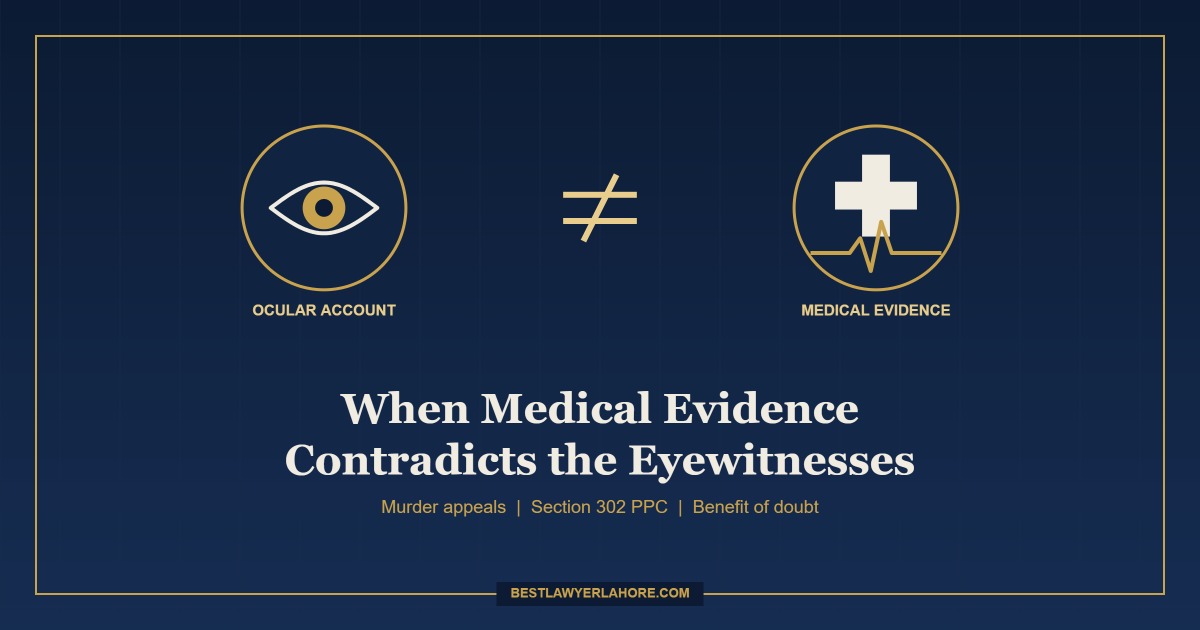
A conflict between the “ocular account” (what the eyewitnesses say) and the “medical evidence” (what the doctor found at the post-mortem) is one of the most common grounds in murder appeals, and one of the most misunderstood. Not every mismatch leads to acquittal. This article explains how the courts actually treat such conflicts, with recent reported judgments, and what an accused’s family should look for in the record.
Why medical evidence matters in a murder trial
In most murder cases under Section 302 of the Pakistan Penal Code, 1860, the prosecution’s main evidence is the eyewitness. Eyewitnesses are often relatives of the deceased, so the court looks for independent material to test their story. The post-mortem report is the most important test.
The doctor records the number of injuries, where they are, which are entry and which are exit wounds, the weapon likely used, whether there is blackening or burning (which shows a close-range shot), and the probable time between injury and death and between death and post-mortem. The doctor’s opinion is relevant as expert evidence under Article 59 of the Qanun-e-Shahadat Order, 1984.
Medical evidence is “corroborative” in nature. It can tell the court how the deceased died, but it cannot tell the court who caused the injuries. Its real value is that it tests whether the eyewitnesses were actually present and saw what they claim to have seen.
The core principle: corroboration and contradiction work together
The Lahore High Court explained this in Muhammad Arshad v. The State (2026 YLR 410). The complainant’s case was that the deceased had been strangled with a cloth. In cross-examination, the doctor admitted there were no marks on the back or front of the neck, and that strangulation with a cloth or rope would leave marks all around the neck. The Court held that the medical evidence, although corroborative, is meant to test the truthfulness of the ocular account, and the two must be read together, not in isolation. The appellants were given the benefit of the doubt.
Put simply, if the witnesses had really been there, their account would have matched the injuries.
When the conflict leads to acquittal
The Supreme Court has acquitted in several recent cases where the conflict went to the root of the prosecution story.
- Wrong number of injuries: In Muhammad Nawaz v. The State (2025 SCMR 1053), the Supreme Court acquitted a man whose death sentence the High Court had reduced to life imprisonment. The Court observed that if the eyewitnesses had been present, they would have described the correct number of injuries. The conflict showed they were not at the spot. The Court repeated the settled rule that even a single circumstance creating reasonable doubt is enough for acquittal.
- Entry and exit wounds: In Iftikhar Ahmad v. The State (2026 SCMR 674), the eyewitnesses said shots landed on the back of the deceased and on the back of his thigh. The doctor found that both those wounds were exit wounds. The Supreme Court called this a “glaring conflict” that cast doubt on the witnesses’ presence, and allowed the appeal.
- Improvements to match the post-mortem: In Amjad Ali v. The State (2026 SCMR 729), the FIR mentioned one rifle-butt blow to the head, but the post-mortem showed two wounds. At trial, the witnesses changed their story to two blows. The Supreme Court held that these were dishonest improvements made to bring the evidence in line with the post-mortem report, and that such witnesses could not be relied upon.
- Blackening and timing: In Saeed Akhtar v. The State (2026 PCrLJ 105), the Lahore High Court noted blackening around the wounds although the site plan showed the shooter about ten to eleven feet away. It also found that the doctor’s estimate of the time of death did not match the time given in the FIR. The conviction was set aside.
When the conflict does NOT help the accused
The courts are just as clear that a minor or explainable mismatch is not a ground for acquittal.
- In Akbar Saeed v. The State (2025 SCMR 935), the Supreme Court held that a person who witnesses a shooting cannot be expected to describe the exact location and direction of every shot. Where the witnesses’ presence was proved and their account was straightforward, a single ground of conflict with the medical evidence was not enough. Leave to appeal was refused.
- In Muhammad Ashraf v. The State (2026 YLR 1016), the witness said the accused had beaten the deceased mercilessly, but the post-mortem showed a single injury. The Lahore High Court noted that the deceased had been under treatment for about two months before death, so minor injuries could have healed. It also accepted that witnesses sometimes exaggerate. Against convincing ocular evidence, this conflict alone did not justify acquittal, and the appeal was dismissed.
The real question, therefore, is whether the conflict is material, meaning it goes to whether the witnesses saw the occurrence at all. A difference in detail that an honest witness could easily get wrong is not enough.
What families should check in the record
If a family member has been convicted and an appeal is being prepared under Section 410 of the Code of Criminal Procedure, 1898 (or a murder reference is pending under Section 374 Cr.P.C. in a death sentence case), the following documents should be compared line by line:
- The FIR: the number of accused, the weapons, the number of shots or blows, and which accused caused which injury.
- The post-mortem report and the doctor’s statement: the number and location of injuries, entry and exit wounds, blackening or burning, the weapon, and the time estimates.
- The inquest report (Section 174 Cr.P.C.) and the site plan: positions of the deceased, the accused and the witnesses, and the distances between them.
- Each eyewitness’s statement: the statement to police compared with the court testimony, looking for improvements made after the post-mortem was known.
- The forensic and ballistic reports: whether they match the weapon and the distance alleged.
Courts also weigh related doubts. In Muhammad Riaz v. Khurram Shehzad (2024 SCMR 51), the Supreme Court upheld an acquittal where the witnesses lived 30 to 35 kilometres away, no source of light was proved for a night-time occurrence, the investigation was defective, and the ocular and medical evidence conflicted.
Bail and suspension of sentence while the appeal is pending
Murder appeals in the High Court can take time. Where a strong conflict between the medical and ocular evidence appears on the face of the record, it can also support an application for suspension of sentence under Section 426 Cr.P.C. Every case depends on its own facts, the length of the sentence and the time already spent in custody.
Conclusion
A conflict between the post-mortem report and the eyewitnesses is not an automatic ticket to acquittal, but where it is material it can be decisive. The Supreme Court and the Lahore High Court consistently hold that the prosecution must prove its case beyond reasonable doubt and that the benefit of any real doubt goes to the accused, as a matter of right and not of grace. Careful, line-by-line study of the FIR, the medical evidence and the witnesses’ statements is where a successful appeal begins.
Case summaries are based on the reported headnotes in the Pakistan Law Site database. The 12 November 2026 Lahore High Court decision is described as reported in the press, pending its publication in the law reports. This article is general legal information, not legal advice for any particular case.
About the author
Muhammad Shafique Baloch, Advocate High Court, has practised criminal, family, civil and constitutional law in Lahore since 2006, including murder appeals, bail matters and writ petitions before the Lahore High Court.
Office: Office No. 3, Basement, Miccop Centre, 1 Mozang Road, near Lahore High Court, Lahore
WhatsApp / Phone: 0321-4960782
Website: www.bestlawyerlahore.com