





Heirs in Pakistan, most often sisters and daughters, have long lost inheritance suits not because their share was in doubt but because they were told they had come too late. Courts were split: one line held that limitation never runs between co-sharers; the other applied the Limitation Act, 1908 in full.
On 13 November 2026, a five-member Larger Bench of the Supreme Court of Pakistan ended that conflict in Mst. Meraj Bibi & another v. Mst. Zar Gula (deceased) through LRs & others, Civil Appeal No. 909 of 2013 and connected matters (judgment authored by Justice Shahid Waheed; announced at Lahore on 13.11.2026; approved for reporting). The Bench comprised Justices Shahid Waheed, Naeem Akhter Afghan, Aqeel Ahmed Abbasi, Shakeel Ahmad and Miangul Hassan Aurangzeb. The full judgment is available on the Supreme Court of Pakistan website.
The Core Rule: Time Runs From the Heir’s Knowledge of a Denial
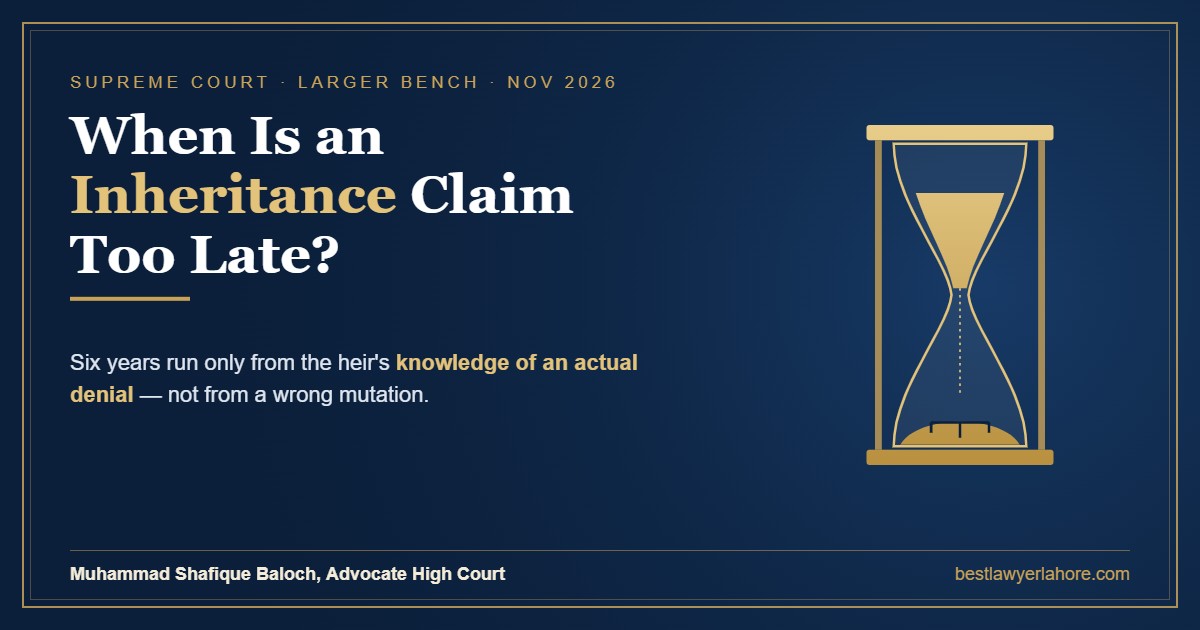
The Court’s central conclusion is that time does not run against the heir; it runs against the heir’s knowledge of a wrong. The right to inherit vests at the moment of death and never lapses. Only the remedy through a civil suit can become time-barred, and only in defined circumstances.
- Governing article: A suit for declaration of a share in inherited property, with or without joint possession, is governed by Article 120 of the Limitation Act, 1908: six years from when the right to sue accrues.
- When time starts: Between co-heirs, the right to sue accrues only on an actual denial of the claimant’s right that is brought home to the claimant. Until then, no clock starts, however many years have passed.
- Burden of proof: The defendant who pleads limitation must prove the actual denial and the claimant’s knowledge of it more than six years before the suit. In every other case, the suit is within time.
- Documents signed by the heir: Where the heir seeks to avoid an instrument to which he or she was a party, Article 91 applies: three years from knowledge of the facts entitling the heir to avoid it. The burden of proving that the instrument was free and understood stays on the beneficiary.
The Court called this “the rule of the known overt act”.
A Wrong Mutation Alone Does Not Start the Clock
This is the most practical part of the judgment. A wrong inheritance mutation, and its repetition in later revenue records, is only a threatened denial. It gives the heir an option to sue but does not start limitation. Knowledge also cannot be inferred from the existence of a revenue entry alone.
The Court listed what does count as an actual denial:
- sale of the heir’s share with delivery of possession, including receiving the sale price or compensation for joint land as sole owner;
- an instrument or transfer mutation setting up exclusive title in another person;
- a demand for the share followed by refusal;
- physical exclusion with an assertion of exclusive ownership; or
- a written repudiation of the claimant’s title, delivered to the claimant personally.
A suit for partition is not barred while the claimant remains in joint possession, actual or constructive.
Silence Is Not Surrender
The Bench held that silence, inaction or delay never amounts to waiver or relinquishment of inheritance. A bare relinquishment of accrued inheritance is void. A share leaves an heir only through a lawful transfer, such as sale, gift, exchange, takharuj or a genuine family settlement, made with free consent after the heir knew the share, and strictly proved by the person relying on it.
Where the denial was hidden by fraud, Section 18 of the Limitation Act postpones time, except against a buyer in good faith for value. A fraudulent transaction to which the heir was not a party does not bind the heir and need not be set aside.
Heirs of Heirs: Successors Can Still Sue
Where the original heir has died, his or her own heirs can sue for the share. They take the claim as it stood:
- barred, if an actual denial was brought home to the predecessor and six years expired in his or her lifetime;
- subject to the remaining balance, if time had started but not expired; and
- running from the successor’s own knowledge, if the predecessor never knew of any denial.
The successor must plead which of these positions applies.
What It Means for Buyers of Inherited Property
A buyer takes no better title than the seller had. A co-heir who sells passes only his own undivided share (Section 44, Transfer of Property Act, 1882). To keep the excluded heir’s share, the buyer must prove one of three protections: Section 41 of the Transfer of Property Act (ostensible owner, consent and good faith after reasonable care); estoppel under Article 114 of the Qanun-e-Shahadat Order, 1984; or limitation, where the heir knew, or by ordinary diligence ought to have known, of the sale more than six years before suing.
A buyer who did not check the family tree, the inheritance record and the seller’s possession is not a buyer in good faith, and long possession does not by itself confer title. Where a buyer is protected, the heir can claim the market value of the share, with mesne profits, from the selling co-heir. Before buying inherited land, see our guide on agreements to sell property in Pakistan.
Directions to Revenue and Registration Authorities
Under Article 187 of the Constitution, the Court directed that:
- no inheritance mutation is attested without a NADRA family registration record (or equivalent proof of all heirs) and written notice to every heir, including female heirs at their own address;
- before any gift, sale or relinquishment mutation by an heir, the revenue officer records the heir’s personal appearance and confirmation that the exact share was explained, before a woman officer for a female heir where available;
- registering authorities, development authorities, cantonment boards and housing societies transfer inherited property only on a succession certificate, letters of administration or a decree, after notice to all heirs; and
- trial courts frame specific limitation issues and decide them on evidence, not on the pleadings alone.
The Court also recommended legislation, including a registered instrument for any relinquishment or takharuj and an amendment to Section 498A PPC to protect male as well as female heirs.
Does It Apply to Your Case?
The judgment governs suits and proceedings pending on 13 November 2026 or filed after it, including appeals, revisions and petitions arising from them. It does not reopen any decree or order that has already attained finality. Once partition follows, our earlier note on stamp duty on partition of inherited property in Punjab will also be relevant.
Frequently Asked Questions
My brother got the land mutated in his name 20 years ago. Is my claim time-barred?
Not on that basis alone. A wrong mutation does not start limitation. The question is whether he did something that clearly denied your share, and whether you knew of it more than six years before you file. He must prove both.
My father never claimed his share from his brothers and has now died. Can I sue?
Yes, as his heir. If your father never knew of an actual denial, time runs from your own knowledge. If he knew and six years passed in his lifetime, the claim is barred.
I signed a relinquishment deed without knowing my share. What is the time limit?
A bare relinquishment of accrued inheritance is void. If you need to set aside a deed you signed, Article 91 applies, three years from when you learned the facts, and the beneficiary must prove the deed was free and understood.
Conclusion
An heir now loses the remedy only after being told, by an unmistakable act, that the share is denied, and then letting six years pass. Pending inheritance and partition suits should be reviewed against this rule. Every case turns on its own facts and documents, and nothing in this article is a substitute for advice on your specific matter.
یہ مضمون اردو میں پڑھیں: وراثت کا دعویٰ کب زائد المیعاد ہوتا ہے؟
About the Author
Muhammad Shafique Baloch, Advocate High Court, has practised law in Lahore since 2006. He handles civil, property, inheritance and partition matters, family cases, criminal defence and bail, banking recovery, writ petitions, and legal work for overseas Pakistanis.
Office No. 3, Basement, Miccop Centre, 1 Mozang Road, near Lahore High Court, Lahore
Phone / WhatsApp: 0321-4960782
Website: www.bestlawyerlahore.com
This article provides general legal information and is not legal advice. Outcomes depend on the facts of each case.