





Urdu: یہ مضمون اردو میں پڑھیں
By Muhammad Shafique Baloch, Advocate High Court, Lahore
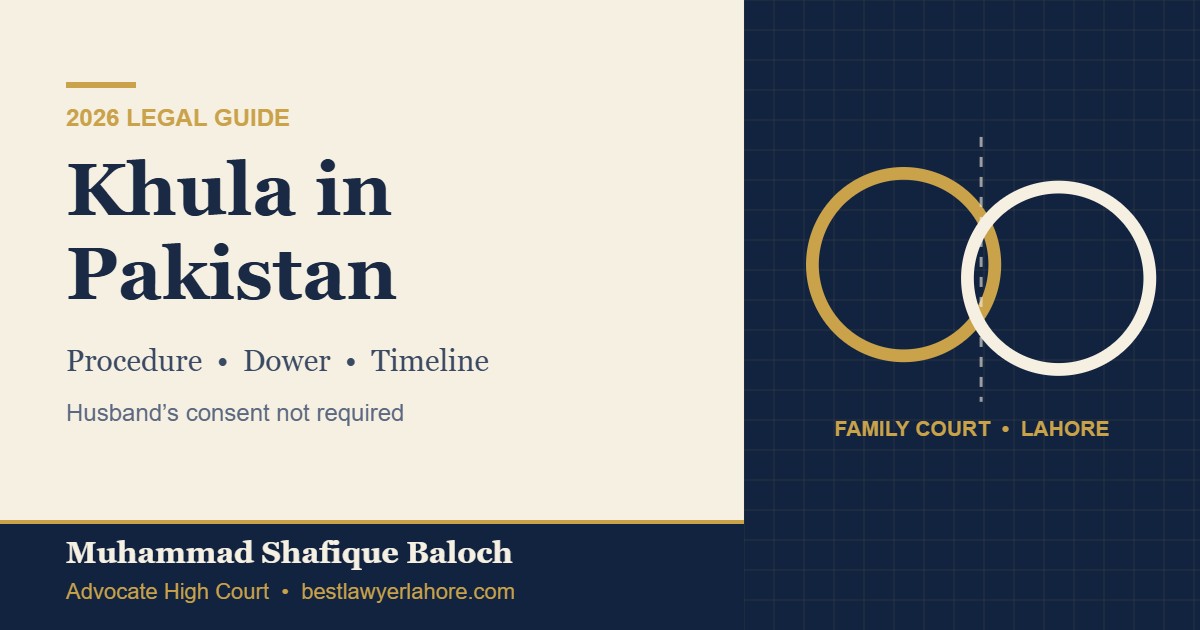
Many women in Pakistan believe they cannot leave a marriage unless the husband pronounces talaq or agrees to let them go. That is not the law. A Muslim wife has an independent right to seek khula, a judicial dissolution of marriage granted by the Family Court, and the husband’s consent is not required. This guide explains what khula is, how a khula case actually runs in a Lahore Family Court, what happens to the dower (haq mehr), and what the Supreme Court has said about it in its most recent judgments.
What is khula?
Khula is dissolution of marriage at the instance of the wife, usually in return for giving up some or all of what she received from the husband, typically the dower. The foundation of the modern law is the Supreme Court’s judgment in Khurshid Bibi v. Baboo Muhammad Amin (PLD 1967 SC 97), which held that a wife is entitled to khula where the court is satisfied that the spouses cannot live together within the limits prescribed by Allah, even if the husband objects. The Lahore High Court had taken the same view earlier in Balqis Fatima v. Najm-ul-Ikram Qureshi (PLD 1959 Lahore 566).
In practical terms, the wife does not have to prove cruelty, desertion or any other fault. It is enough that she satisfies the court that she cannot continue the marriage, which in most cases is shown by her firm and consistent stand in the plaint and before the court.
Khula is not the same as dissolution on grounds
A wife can also seek dissolution on specific grounds under section 2 of the Dissolution of Muslim Marriages Act, 1939, for example failure to maintain her for two years, cruelty, or a second marriage without the permission required by the Muslim Family Laws Ordinance, 1961. The difference matters because of dower: where the marriage is dissolved on a proved ground, the wife keeps her full dower; where it is dissolved by khula, the court may ask her to give part of it back.
The Supreme Court has repeatedly stressed that courts must respect this choice. In Ibrahim Khan v. Saima Khan (C.P. No. 4657 of 2022, decided 15 February 2024), it held that a court cannot pass a decree of khula on its own if the woman has not asked for it, because her consent is essential. In January 2026, a bench headed by Chief Justice Yahya Afridi, in a judgment written by Justice Musarrat Hilali, set aside concurrent khula decrees in a wife’s appeal against a Peshawar High Court decision, because she had sought dissolution on grounds, not khula. The Court dissolved the marriage on those grounds and ordered her full unpaid dower to be paid.
Lesson for every plaintiff: the plaint should state clearly whether you are seeking khula, dissolution on grounds, or both in the alternative. This one drafting choice can decide whether you keep your dower.
The husband’s consent is not required
In Dr. Seema Hanif Khan v. Waqas Khan (Supreme Court, October 2025), Justice Ayesha A. Malik held that the High Court had erred in making dissolution depend on the husband’s consent. The Supreme Court described khula as the wife’s own right, which cannot be made conditional on the husband’s willingness, and restored the Family Court’s decree. The same judgment recognised psychological abuse as a form of cruelty.
Khula procedure in Lahore, step by step
- Choose the right court. The suit is filed before the Family Court (Senior Civil Judge, Family Division, in Lahore). Under the West Pakistan Family Courts Rules, 1965, a wife may sue where she ordinarily resides, so she does not have to go to the husband’s city.
- File the plaint. The plaint is filed with a copy of the nikahnama, the wife’s CNIC, and the particulars of the husband. Under section 7 of the Family Courts Act, 1964, a suit for dissolution can also include claims for dower, dowry articles, maintenance, personal belongings and custody of children, so everything can be decided in one case.
- Summons to the husband. The court issues notice to the husband by the modes the law allows, including registered post and, where needed, publication. If he does not appear, the case can proceed ex parte.
- Pre-trial reconciliation. After the written statement, the court makes an attempt at reconciliation under section 10 of the Family Courts Act. Where the wife maintains that she cannot live with the husband, reconciliation fails.
- Decree. In Punjab, after the 2015 amendment, section 10(5) requires the court, once reconciliation fails in a dissolution suit, to pass the decree immediately. In a khula decree the court may direct the wife to surrender up to fifty percent of her deferred dower or up to twenty-five percent of her admitted prompt dower. Under section 10(6), the court directs the husband to pay the outstanding deferred dower, subject to that adjustment.
- After the decree. A copy of the decree is sent to the Chairman of the Union Council concerned. The dissolution becomes effective on the expiry of ninety days, in line with the scheme of the Muslim Family Laws Ordinance, 1961, after which a divorce or effectiveness certificate can be obtained and the marital status updated with NADRA.
What happens to dower, dowry and maintenance?
Khula does not automatically mean the wife loses everything. In Punjab the court’s power is capped: it may direct her to return up to 50% of the deferred dower or 25% of the admitted prompt dower, not more. Her dowry articles and personal belongings remain her property and can be claimed in the same suit. Past maintenance and the maintenance of children are separate rights and are decided on their own merits. Where the husband’s conduct supports a ground under the 1939 Act, it is often wiser to plead that ground as well, so the court can dissolve the marriage without any deduction from dower.
Can the husband appeal?
Section 14 of the Family Courts Act, 1964 restricts appeals against a decree for dissolution of marriage; generally no appeal lies, except where dissolution is granted on the specific ground in section 2(viii)(d) of the 1939 Act. Appeals on the money claims (dower, dowry and maintenance) remain available within the limits of that section. A husband who believes a decree was obtained without proper notice can apply to set aside an ex parte decree, which is why correct service on him matters even in uncontested cases.
Documents to bring to your lawyer
- Nikahnama (original or certified copy from the Union Council)
- CNIC of the wife, and the husband’s CNIC number and address if known
- List of dowry articles, with receipts or photographs where available
- Details of dower: amount, prompt or deferred, and what has been paid
- Children’s B-forms or birth certificates, if custody or maintenance is claimed
- Any messages, medical reports or police complaints relevant to the husband’s conduct
Frequently asked questions
How long does a khula case take in Lahore?
An uncontested case, where the husband does not appear or does not oppose, can be decided within a few months. A contested case with money claims takes longer, depending on the court’s cause list and how the evidence on dower and dowry proceeds.
Does the wife have to appear in court?
Yes. The court needs her own statement, particularly at the reconciliation stage, and the Supreme Court has said that a khula decree must reflect her clear and voluntary choice.
Can a woman living abroad file for khula in Pakistan?
Yes. She can authorise a representative through a properly attested power of attorney, although the court may still require her statement, which can be arranged through the procedures the court permits.
Is iddat required after khula?
Yes. After the dissolution takes effect, the wife observes iddat before she can remarry.
Disclaimer: This article is general legal information on Pakistani law as of October 2026 and is not legal advice for any particular case. The facts of every case differ; please consult a qualified lawyer about your own matter.
About the Author
Muhammad Shafique Baloch, Advocate High Court, has practised family, criminal, civil and constitutional law in Lahore since 2006, acting for both wives and husbands in khula, dissolution, dower, dowry, maintenance and custody cases before the Family Courts and the Lahore High Court.
The Best Law Firm, Advocates & Legal Consultants
Office: Office No. 3, Basement, Miccop Centre, 1 Mozang Road, Near AG Office Chowk / Lahore High Court, Lahore
WhatsApp / Phone: 0321-4960782