





Urdu: یہ مضمون اردو میں پڑھیں
Punjab changed its law on child marriage in 2026. The minimum age for marriage is now eighteen for both men and women, and the punishments are far heavier than under the old law. Within months, the courts faced an obvious question: what happens to marriages solemnised before the new Act came into force?
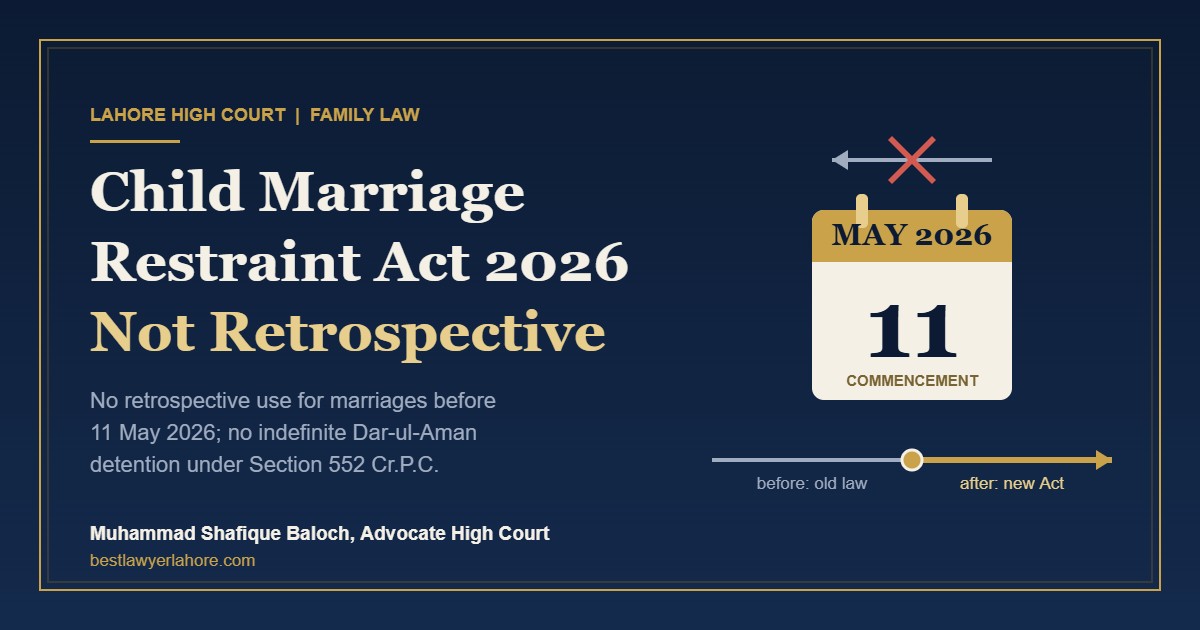
In a judgment reported on 5 November 2026, the Lahore High Court (Justice Khalid Ibn-i-Aziz) answered that the Punjab Child Marriage Restraint Act 2026 cannot ordinarily be applied to events that took place before its commencement. In the same judgment, the Court held that Section 552 of the Code of Criminal Procedure, 1898 does not allow a court to keep a woman in a shelter home (Dar-ul-Aman) indefinitely against her expressed wishes.
The Punjab Child Marriage Restraint Act 2026 in brief
The Act (Act XXVII of 2026) was passed by the Provincial Assembly of the Punjab on 27 April 2026 and published in the Punjab Gazette on 11 May 2026, taking effect at once. It replaced a Child Marriage Restraint Ordinance promulgated earlier in 2026, and it repealed the Child Marriage Restraint Act, 1929 for the Punjab. Its key features are:
- Age: a “child” is any person, male or female, under eighteen years of age (section 2).
- Nikah Registrars: a Nikah Registrar must not register a child marriage. Doing so is punishable with up to one year’s simple imprisonment and a fine (section 3).
- Adult marrying a child: rigorous imprisonment of two to three years and a fine of up to Rs 500,000 (section 4).
- Cohabitation: cohabitation arising from a child marriage is treated as child abuse, whatever the child’s consent, and carries five to seven years’ imprisonment and a fine of not less than Rs 1,000,000 (section 5).
- Child trafficking: taking a child out of the Punjab to evade the Act is separately punishable (section 6).
- Parents and guardians: anyone who promotes or permits a child marriage, or negligently fails to prevent it, faces two to three years’ rigorous imprisonment (section 7).
- Procedure: offences are triable only by the Court of Sessions (section 8). All offences are cognizable, non-bailable and non-compoundable (section 10). The trial is to conclude within ninety days of cognizance (section 11).
- Best interests of the child: the child’s best interests are a primary consideration at every stage. A child who is a party to the marriage is not to be treated as an offender, and a child’s apparent consent does not by itself decide custody (section 13).
The 1929 law had fixed the age at sixteen for females and carried light punishments. The change is substantial, which is exactly why retrospectivity matters.
The case: facts as reported
According to press reports of the judgment, a couple from District Khushab contracted nikah on 18 April 2026, more than three weeks before the 2026 Act came into force. The girl’s father lodged an FIR alleging abduction under Section 365-B of the Pakistan Penal Code and relied on a birth registration certificate to claim that she was under sixteen.
Before a Magistrate, in a statement under Section 164 Cr.P.C., the girl said that she had married of her own free will, that she had not been abducted, and that she wished to live with her husband. She also disputed the claim that she was a minor.
On 20 May 2026, the Sessions Judge, Khushab, treated her as under sixteen and sent her to Dar-ul-Aman. No date was fixed for her release. The husband’s parents filed a criminal revision in the Lahore High Court, and the girl’s father filed a constitutional petition.
What the Lahore High Court held
As reported, Justice Khalid Ibn-i-Aziz allowed the criminal revision, set aside the Sessions Court’s order of 20 May 2026, and dismissed the father’s constitutional petition. The main holdings are these:
1. The 2026 Act does not reach back in time. Legislation cannot ordinarily be applied to events that occurred before its commencement. The marriage was solemnised on 18 April 2026 and the Act took effect on 11 May 2026, so the new Act could not be used to start or support proceedings about that marriage.
2. Section 552 Cr.P.C. is not a power of detention. Section 552 lets a Magistrate order the restoration of an abducted or unlawfully detained woman to her liberty, or of a female child to her lawful guardian. The Court held that it does not authorise a court to detain a woman in a shelter home, and certainly not indefinitely.
3. Denial of abduction and disputed age change the picture. Where the woman denies abduction and disputes the claim that she is a minor, the basis for continuing Section 552 proceedings must be reassessed. Proceedings cannot simply carry on as though the allegations were proved.
4. Her free will was respected. The Court declared that she was free to live wherever she chooses.
Why the ruling matters
Constitutional footing. Article 12 of the Constitution of Pakistan protects against retrospective punishment: no law may authorise punishing a person for an act that was not punishable by that law when it was done, or impose a greater penalty than the law then prescribed. The judgment applies the same general principle: a new penal statute speaks to the future unless the legislature clearly says otherwise.
The old law does not disappear. Retrospectivity does not mean that a marriage solemnised before 11 May 2026 escapes all scrutiny. Under the general rule on the effect of repeal in the Punjab General Clauses Act, 1956, liabilities incurred under a repealed law may ordinarily still be pursued under that law, and the 2026 Act itself saves orders made under the laws it repeals (section 15). A pre-May 2026 marriage is therefore judged by the law in force when it took place, including the 1929 Act and the ordinance then in force, not by the harsher 2026 Act.
Shelter homes are protection, not punishment. Courts often send young women to Dar-ul-Aman when a family contests a marriage. This judgment is a clear reminder that such a placement needs a legal basis, must be justified on the facts and must not be open-ended. An adult woman’s statement that she wants to live with her husband carries real legal weight.
Age disputes need evidence. Where age is contested, courts weigh birth registration, school and NADRA records and, where needed, medical evidence. A disputed certificate should be tested, not assumed.
Practical guidance
For parents and guardians: For marriages from 11 May 2026 onwards, any marriage where either party is under eighteen exposes parents, guardians, the Nikah Registrar and the adult spouse to non-bailable charges in the Court of Sessions. If you learn that a child marriage is being arranged, the Sessions Court can grant an injunction to stop it.
For couples married before 11 May 2026: The 2026 Act should not be invoked against your marriage. Keep your Nikahnama, your NADRA records and any age documents ready, and get legal advice promptly if an FIR or a Section 552 or habeas application is filed.
For women sent to Dar-ul-Aman: An order under Section 552 Cr.P.C. can be challenged in revision before the Sessions Court or the Lahore High Court. Where detention is unlawful, a petition under Section 491 Cr.P.C. or Article 199 of the Constitution may also be available.
Conclusion
The Punjab Child Marriage Restraint Act 2026 is a serious and welcome step to protect children. Its force, however, lies in the future. The Lahore High Court has confirmed that it cannot be used against marriages solemnised before 11 May 2026, and that Section 552 Cr.P.C. does not authorise a court to keep a woman in a shelter home indefinitely against her will. Each case still turns on its own facts, especially on age evidence and the circumstances of the marriage, so early legal advice is essential.
This article is for general information and does not constitute legal advice. The facts and holdings of the judgment are taken from published press reports; readers should consult the certified copy of the judgment.
About the author
Muhammad Shafique Baloch, Advocate High Court, has practised law in Lahore since 2006 in family, criminal, constitutional and civil matters before the Lahore High Court and the subordinate courts.
Office No. 3, Basement, Miccop Centre, 1 Mozang Road, near Lahore High Court, Lahore
WhatsApp / Phone: 0321-4960782
Website: www.bestlawyerlahore.com