





Illegal possession (qabza) of land and houses is one of the most common complaints in Punjab. An owner returns from abroad to find a stranger in his house, or a plot bought years ago now has someone else’s boundary wall on it. Until recently the usual answers were a civil suit that could run for years, or a complaint under the Illegal Dispossession Act 2005.
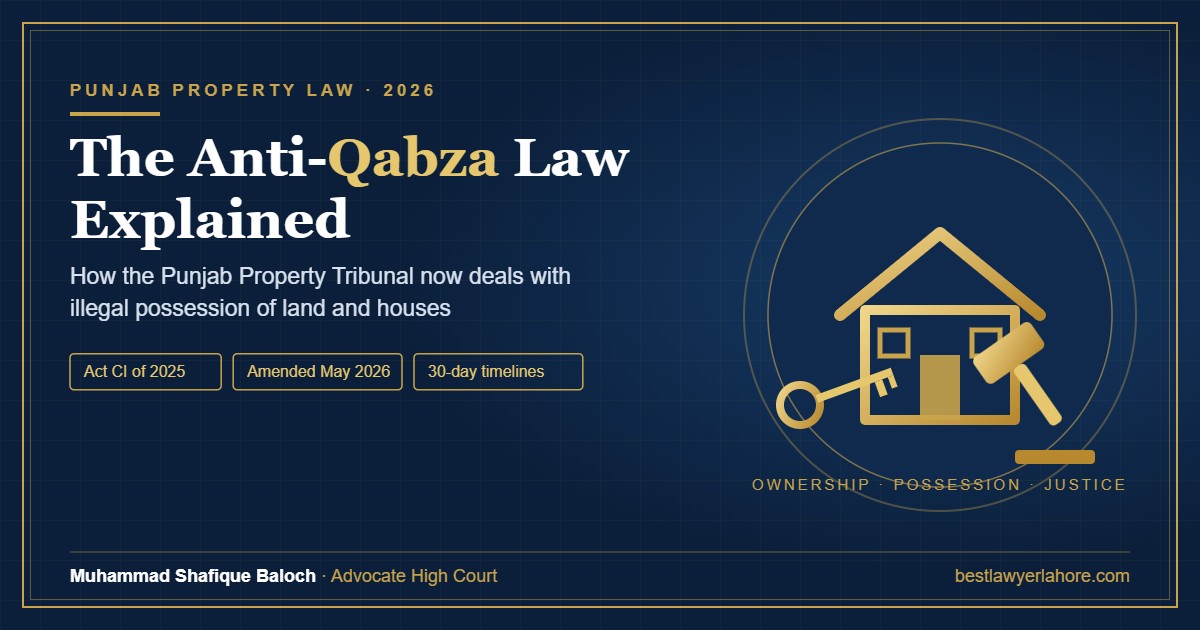
The Punjab Protection of Ownership of Immovable Property Act 2025 (Act CI of 2025) created a faster route. In its first year it was challenged in the Lahore High Court and then substantially rewritten in May 2026. This article explains the law as it now stands, based on the official text and recent Lahore High Court judgments.
How the law reached its present form
The law was enacted in December 2025. In its original form, committees headed by Deputy Commissioners decided complaints, and some handed over possession themselves. On 22 December 2025 the Chief Justice of the Lahore High Court suspended the operation of the law and the committees’ possession orders, and referred the challenges to a full bench (as reported by Dawn).
The Government first amended the law by ordinance (Ordinance II of 2026) and then by the Punjab Protection of Ownership of Immovable Property (Amendment) Act 2026 (XXXVII of 2026). The Assembly passed it on 7 May 2026 and it was published in the Gazette on 14 May 2026. Decisions now rest with a judicial officer, not the district administration. In June 2026, serving Additional Sessions Judges were notified as Punjab Property Tribunals across the province.
What counts as an offence
Under the substituted section 4, an accused commits illegal possession if he, himself or through another, obtains or retains possession of immovable property without lawful authority or lawful means, or through fraud, cheating, forgery, misrepresentation, intimidation, force, coercion or other illegal means.
- Punishment: five to ten years’ imprisonment, or a fine up to Rs10 million, or both (section 4).
- Attempt, abetment or conspiracy: one to three years, or a fine up to Rs1 million, or both (section 5).
- “Accused” under section 2(aa) includes companies, firms, societies and trusts, and also their directors, partners, beneficial owners and anyone in control of their affairs.
The words “obtains or retains” matter. Under the Illegal Dispossession Act 2005, the Lahore High Court has held that protection extends only to an owner who was in possession and was unlawfully dispossessed, not to a mere owner (Malik Muhammad Saeed etc. v. Lal Khan etc., Crl. Appeal No. 1169 of 2025, Rawalpindi Bench, decided 4 February 2026, 2026 LHC 1715). The new Act is built around the lawful owner’s title and anyone wrongfully holding the property. Like the 2005 Act, which the Supreme Court in Mst. Gulshan Bibi v. Muhammad Sadiq (PLD 2016 SC 769) held is not confined to professional land-grabbers, it applies to anyone who occupies land unlawfully.
The procedure, step by step
1. Complaint to the Tribunal
Under section 7, the lawful owner files a complaint directly before the Punjab Property Tribunal of the district where the property is located. It must identify the property, state the facts constituting the offence, attach evidence of lawful title, and give the known particulars of the accused.
2. Scrutiny Committee report within 30 days
Within three days the Tribunal refers the complaint to the district Scrutiny Committee (section 8). The Committee is convened by the Deputy Commissioner and includes the DPO, ADC (Revenue), Assistant Commissioner, SDPO, Circle Revenue Officer and SHO. It examines records, records statements, encourages settlement and must report within thirty days. A settlement goes to the Tribunal for approval and a decree. The Committee itself cannot hand over possession.
3. Preventive and interim orders
An owner who fears an attempt to occupy his property can ask the Tribunal for preventive measures, such as a surety or sealing of the property (section 9). While the case is pending, the Tribunal may pass interim orders regulating possession and direct the police to enforce them (section 10).
4. Trial and decision
The Tribunal tries the offence under Chapter XXII-A of the Code of Criminal Procedure and has exclusive jurisdiction to decide title (section 16(2)). The case proceeds day to day and is to be decided within thirty days of the Committee’s report. No adjournment may exceed seven days (section 16(6)). The Tribunal may order arrest at any stage, and only the Lahore High Court can grant bail to a person arrested in this way (sections 16(9) and 16(10)).
5. Restoration and compensation
The Tribunal orders possession to be delivered or restored to the lawful owner (section 18). It may award compensation of not less than the property’s value under the Stamp Act valuation table, plus any profit made from the property, recoverable as arrears of land revenue (sections 16(7) and 16(8)).
Safeguards against misuse
- False complaints: a complaint found false, frivolous or vexatious can bring one to five years’ imprisonment and a fine up to Rs500,000 (section 16(3)).
- No alienation: once a complaint is filed, any sale, gift, lease or mortgage of the property is void unless the Tribunal permits it (section 20).
- Transfer of pending cases: a lawful owner may ask the court where an illegal possession case is already pending (other than the Federal Constitutional Court, Supreme Court or Lahore High Court) to transfer it to the Tribunal. The court must decide within fifteen days (section 16(11)).
Appeal lies only against the final judgment
A convicted person, the complainant, or the prosecutor (on the Prosecutor General’s written direction) may appeal to the Lahore High Court within thirty days of the final judgment or decree, and the appeal is to be decided within thirty days (section 19). There is no appeal or revision against an interim order or a decree based on a settlement before the Committee.
The Lahore High Court applies this strictly. In Ayyaz Ahmad and 5 others v. Punjab Property Tribunal etc. (W.P. No. 10974 of 2026, Multan Bench, decided 14 September 2026, 2026 LHC 7003), a writ petition against an interim possession order was dismissed. Because section 19(3) bars any appeal or revision against interim orders, the Court held that it cannot act as an appellate or revisional forum under Article 199. In practice, the Committee stage and the interim hearing must be contested carefully, because there is little chance to correct mistakes later.
Choosing the right forum
In Syed Ali Ahsan v. Asif etc. (decided 29 September 2026, 2026 LHC 6697), the Lahore High Court held that lawful ownership and sufficient particulars identifying the property are prerequisites for approaching the Tribunal. It also held that section 16(11) does not permit parallel remedies before a civil court and the Tribunal on the same subject matter. Choose one forum with care. A dispute between co-sharers may still suit a partition or inheritance claim. Where other crimes accompany the occupation, remedies for registering an FIR may also be available.
Frequently asked questions
Can an overseas Pakistani file a complaint?
Yes, through a properly executed power of attorney and counsel. Under section 8(6), a party unable to appear before the Committee in person may, with its permission, appear electronically subject to biometric verification.
Do I still need a civil suit to establish title?
Not necessarily. The Tribunal decides title in the case before it and passes a decree. You cannot pursue the same relief in a civil court and the Tribunal at the same time.
What if the Tribunal passes a wrong interim order?
There is no appeal or revision, and the LHC has refused to entertain a writ petition in such a case. Raise every objection before the Committee and the Tribunal, and appeal against the final judgment within thirty days.
Conclusion
After the 2026 amendment, Punjab’s anti-qabza law is a judicial process with short deadlines, heavy penalties and narrow appeal rights. It can return property to its lawful owner within months, but its timelines are unforgiving for anyone who arrives unprepared, owner or accused alike. Its constitutional validity has been questioned in the Lahore High Court, so current case law should be checked before relying on any provision. Every case turns on its own documents and facts, and nothing in this article is a substitute for advice on your specific matter.
یہ مضمون اردو میں پڑھیں: پنجاب کا انسدادِ قبضہ قانون: پراپرٹی ٹربیونل ناجائز قبضے کے مقدمات کیسے نمٹاتا ہے؟
Need advice on an illegal possession matter? Call or WhatsApp 0321-4960782.
About the Author
Muhammad Shafique Baloch, Advocate High Court, has practised law in Lahore since 2006. He handles civil, property, inheritance and partition matters, family cases, criminal defence and bail, banking recovery, writ petitions, and legal work for overseas Pakistanis.
Office No. 3, Basement, Miccop Centre, 1 Mozang Road, near Lahore High Court, Lahore
Phone / WhatsApp: 0321-4960782
Website: www.bestlawyerlahore.com
This article provides general legal information and is not legal advice. Outcomes depend on the facts of each case.