





Urdu: یہ مضمون اردو میں پڑھیں
When a parent dies leaving a house, a plot or agricultural land, the legal heirs become co-owners of it. Dividing that property so that each heir holds a defined portion is called partition. It can be done by agreement among the heirs, through the Revenue Department, or by a civil court decree.
Heirs in Punjab have often been asked to pay stamp duty as a percentage of the property’s value, sometimes 2%, before a partition decree is drawn up. On a Lahore house worth several crore rupees, that can mean lakhs of rupees.
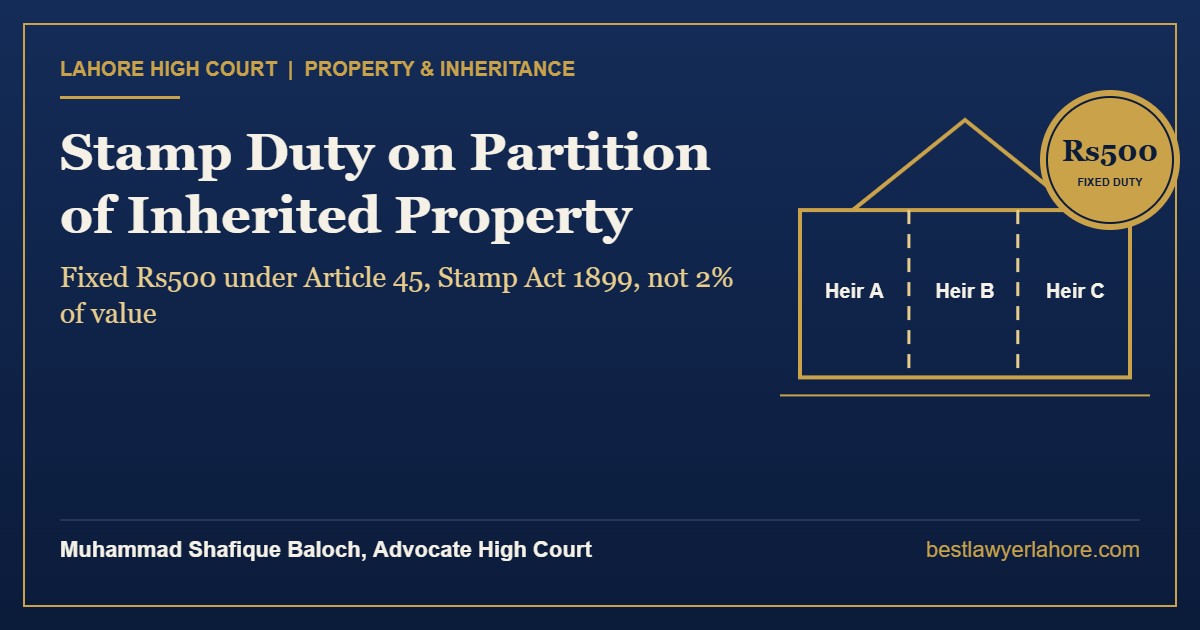
In October 2026 Justice Tanveer Ahmed Sheikh of the Lahore High Court held that partition of inherited property attracts a fixed stamp duty of Rs500, not a percentage of its value. This article explains the ruling, the law and the case law behind it, and what heirs should do.
What the Lahore High Court Decided
According to a report published in Daily Pakistan on 21 October 2026, the Lahore High Court accepted a writ petition filed by a legal heir in a partition matter. A civil judge and an additional sessions judge had required stamp duty at 2% of the property’s value. Their orders were passed in 2025.
The High Court set aside both orders. The reported reasoning was:
- The courts below had given no legal basis for charging 2% on a partition of inherited property.
- The duty applicable under the Stamp Act, 1899 to such a partition is a fixed Rs500.
- Adding other co-owners as parties to the case did not change its nature. It remained a partition of inherited property.
- A percentage-based financial burden cannot be imposed without lawful authority.
The last point reflects a basic constitutional principle. Under Article 77 of the Constitution of Pakistan, no tax can be levied except by or under the authority of law made by the legislature. Article 127 applies the same rule to the provinces and the Provincial Assemblies. Stamp duty is a tax. The Supreme Court made a similar point in Chaklala Cantonment Board, Rawalpindi v. Ahmad Kamal Nasir (PLD 2020 SC 386). A determination that places a financial burden on a taxpayer needs express authorisation in the law. No court office or registration official can charge more than the statute allows.
Note: At the time of writing, the October 2026 judgment had not yet appeared in the law reports, including PakistanLawSite. It is therefore cited here as reported in the press, and readers should obtain a certified copy before relying on it in proceedings.
The Law: Article 45 of the Stamp Act, 1899 (as Applicable in Punjab)
What is an “instrument of partition”?
Section 2(15) of the Stamp Act, 1899 defines an “instrument of partition” as any instrument by which co-owners of property divide, or agree to divide, that property in severalty. Importantly, the definition also includes a final order for effecting a partition passed by a Revenue-authority or a Civil Court, and an award by an arbitrator directing a partition.
So a final partition decree from a civil court in Lahore, or a partition order passed by a Revenue Officer, is itself treated as an instrument of partition for stamp-duty purposes. The Supreme Court confirmed this in Khawaja Muhammad Arif v. Mrs. Tahira Asif (PLD 2005 SC 972). A partition decree must be engrossed on stamp paper, and until that is done it can neither be executed nor acted upon.
The reverse is also true. A decree or order that does not actually effect a partition does not attract duty under Article 45. Examples are an order for sale of the property, or a preliminary decree that only declares shares. See Muhammad Sulaiman Malik v. Royal Trust Corporation of Canada (PLD 1983 Karachi 382) and Sameera Rafiq v. Modleen (1999 YLR 1199 Karachi).
What duty does Article 45 impose?
Article 45 of Schedule I of the Stamp Act, as amended for Punjab, generally charges partition duty as a percentage of the value of the separated share or shares of the property. The largest share is treated as the share from which the others are separated, so duty is not charged on it.
However, the Punjab Finance Act, 2012 inserted a special provision into the same Article. Paraphrased, it says that, notwithstanding anything else in the Article, a fixed stamp duty of five hundred rupees shall be charged on an instrument of partition relating to urban or rural property, including agricultural land, which is partly or wholly based on the opening of inheritance.
This is the provision behind the Rs500 figure. The legislature deliberately chose not to burden heirs with value-based duty when they divide what they have inherited. Their ownership comes from succession, not from a sale or purchase.
Who pays?
Under Section 29(g) of the Stamp Act, unless there is an agreement to the contrary, the parties bear the duty in proportion to their shares in the whole property partitioned. Where partition is made under an order of a court, revenue authority or arbitrator, the duty is borne in the proportion that authority directs. In Mian Muhammad Asif v. Mst. Farkhanda Anwar (2003 CLC 394 Lahore), the Lahore High Court explained the reason. In a partition suit every party is both a decree-holder and a judgment-debtor, so the burden of stamp duty is shared by all of them. (That judgment applied the percentage rate in force at the time, before the 2012 inheritance provision was inserted.)
Why the 2% Demand Was Wrong
Percentage rates do appear elsewhere in Schedule I. Conveyance (Article 23) and decrees based on mutual consent that involve a transfer of immovable property are charged as a percentage of value. Partition among heirs, however, is not a transfer. Each heir already owns an undivided share from the moment of the predecessor’s death. The Lahore High Court reaffirmed this in Muhammad Riaz v. Mst. Najma Bibi (2026 YLR 1912). Co-heirs become co-owners immediately on the death of their predecessor, and that succession does not need any intervention by the revenue functionaries. Partition only converts that undivided share into a defined portion on the ground.
Treating a partition decree as a conveyance or a transfer-type consent decree confuses two different legal transactions. Where the property is inherited, the specific Rs500 provision in Article 45 governs. A general percentage entry cannot override it.
How Partition of Inherited Property Works in Punjab
There are two main routes, and the choice depends on the type of property:
- Revenue partition (agricultural land). For land assessed to land revenue, partition is ordinarily sought before the Revenue Officer under Chapter XI of the Punjab Land Revenue Act, 1967. The inheritance mutation should be sanctioned first so that each heir’s share is recorded in the Record of Rights.
- Civil suit for partition (urban property such as houses, plots and shops). A co-owner files a suit for partition and separate possession before the Civil Court. Under Order XX Rule 18 of the Code of Civil Procedure, 1908, the court first passes a preliminary decree declaring the shares. A final decree then actually divides the property, often after a local commission. If the property cannot be divided conveniently, the court may order its sale under the Partition Act, 1893 and distribute the proceeds according to shares.
For agricultural land, the Punjab Board of Revenue has held that inherited land should be divided so that every heir receives land of equal value, even if the blocks are not perfectly compact. See Nazar Abbas v. The State (2026 CLC 471 Board of Revenue Punjab).
Stamp duty usually becomes an issue at the final decree stage, when the decree must be engrossed on stamp paper. This is where heirs have been asked to pay percentage-based duty. Three points from the case law matter here:
- The court cannot withhold drawing up the final decree pending payment of stamp duty. However, the decree will not be executable until the duty is paid. See Mst. Rashidan Bibi v. Aman Ullah Khan Bangash (PLD 2016 Lahore 602).
- The court has inherent power to extend the time for depositing stamp duty, and a partition suit is not to be lost on that technicality alone. See Zamurrad Hussain v. Muhammad Younas (2014 MLD 522 Lahore).
- Where a decree sheet is delayed because of the court’s own office, the principle that an act of the court shall prejudice no one applies. See Syed Imtiaz Hussain (Deceased) v. Muhammad Hussain (PLD 2026 Lahore 404).
Practical Guidance for Heirs and Co-Owners
- Establish the inheritance link on record. Keep the death certificate, Family Registration Certificate (NADRA), inheritance mutation or succession documents, and title documents of the deceased on file. The Rs500 rate applies where the partition is “partly or wholly based on opening of inheritance”, so this must be clear from the pleadings and the record.
- Object at once if a percentage is demanded. File a written application before the trial court citing Article 45 of Schedule I of the Stamp Act as applicable in Punjab, and the recent Lahore High Court ruling.
- Challenge an adverse order promptly. An order demanding excessive stamp duty can be challenged in revision under Section 115 CPC. Where appropriate, it can also be challenged through a constitutional petition under Article 199 before the Lahore High Court, as happened in the reported case.
- Mixed cases need care. If part of the property was purchased by the co-owners rather than inherited, the duty position may differ for that part. Take advice on how the shares are described in the plaint.
Conclusion
The ruling restores what the Punjab legislature intended. When heirs divide what they have inherited, the duty is a fixed Rs500, not a share of the property’s value. A wrongful percentage demand at the final decree stage should be challenged early.
Every case turns on its own facts and documents, and nothing in this article is a substitute for advice on your specific matter.
About the Author
Muhammad Shafique Baloch, Advocate High Court, has practised law in Lahore since 2006. He handles civil, property, inheritance and partition matters, family cases, criminal defence and bail, banking recovery, writ petitions, and legal work for overseas Pakistanis.
Office No. 3, Basement, Miccop Centre, 1 Mozang Road, near Lahore High Court, Lahore
Phone / WhatsApp: 0321-4960782
Website: www.bestlawyerlahore.com
This article provides general legal information and is not legal advice. Outcomes depend on the facts of each case.