
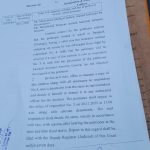
A Landmark Judgment in W.P. No. 62097/2025 (Reported as 2025 LHC 6163)
A comprehensive analysis of the Lahore High Court judgment 2025 LHC 6163 on minority quota appointments, establishment definition, and constitutional jurisdiction under Article 199.Focus Keyword: 2025 LHC Introduction. In a significant and far-reaching judgment, the Lahore High Court, while deciding Writ Petition No. 62097 of 2025, reported as 2025 LHC 6163, has clarified the scope and legal boundaries of minority quota in public service appointments. The Court answered a crucial constitutional question:Can the judiciary or certain public institutions be classified as “establishments” to which minority quota applies?The Court’s answer was a clear No, thereby setting a defining precedent for future recruitment and service litigation.This judgment provides authoritative guidance on the interpretation of minority protection laws, recruitment policies, and the jurisdiction of the High Court under Article 199 of the Constitution. It is particularly important for minority applicants, government departments, and service law practitioners.—
Background of the CaseThe petitioner, Naseeb Masih, invoked the constitutional jurisdiction of the Lahore High Court under Article 199, challenging the denial of his claim to be considered under the minority quota for a post which, according to him, legally fell within the scope of minority reservation.The respondents included the President of Pakistan through his Principal Secretary, among other governmental authorities. The core contention was whether the minority quota policy could be enforced in relation to posts that are not statutorily recognized as part of the “establishment” entitled to quota-based appointments.—Key Legal Questions Before the Court.
1. Does the Judiciary Fall Under the Definition of “Establishment”?The Court categorically held that:The judiciary is a constitutional organ, not an establishment or department in the ordinary sense of public employment.Quota policies designed for general public service recruitment cannot automatically be extended to the judiciary.
2. Can Minority Quota Be Universally Applied?The Court reaffirmed:Minority quota is policy-based and must be expressly provided in the relevant rules.It cannot be implied or extended beyond the scope of approved service structures and recruitment frameworks.
3. Is a Writ Petition Maintainable in Such Cases?Yes — the Court held that:When fundamental rights are invoked, particularly those concerning equality, non-discrimination, and legitimate expectation, the High Court’s jurisdiction under Article 199 is fully attracted.Even in service matters, if constitutional rights are involved, writ jurisdiction remains open to minorities seeking justice.—
Court’s Findings. The Lahore High Court delivered a reasoned and principle-based judgment, holding that:Minority quota is not an absolute right; it exists only within the contours of the applicable rules.The judiciary, being a constitutional institution, cannot be treated as an “establishment” for quota purposes.No illegal discrimination occurred, as the policy itself did not apply to the post claimed by the petitioner.—
Practical Implications of the Judgment
✅ For Minority Candidates Carefully examine whether the post you are applying for is expressly covered under minority quota rules.This judgment prevents misinterpretation of quota policies and protects the system from overextension .
✅ For Legal Practitioners This case serves as a strong precedent when advising clients on service matters, constitutional litigation, or recruitment disputes.The judgment must be cited where minority claimants seek quota benefits outside established frameworks.
✅ For Government Departments Authorities must ensure clarity in notifications and recruitment advertisements.Any ambiguity may lead to constitutional litigation.—
Why This Judgment Matters. it protects the integrity of the judiciary by preventing misapplication of service rules.It upholds constitutional principles by clarifying the legal status of minority quota in public administration.It guides future litigation, making it clear when Article 199 can be invoked in service matters affecting fundamental rights.—
Conclusion. The Lahore High Court’s judgment in 2025 LHC 6163 serves as a judicial milestone in defining the limits of minority quota application within Pakistan’s public service framework. It not only preserves the sanctity of the judiciary as a constitutional organ but also sets clear legal parameters for both minority candidates and policy-makers.This decision is a must-cite authority in future constitutional petitions, service matters, and quota-related litigation.—Call to Action (For Website Engagement)If you are a public servant, minority applicant, or government employee facing issues related to quota, recruitment, or constitutional rights, you can consult our law chambers for expert representation before the High Court.📞 Contact: 0321-4960782🌐 Website: www.bestlawyerlahore.com✉ Email: lawyerbaloch@gmail.com@gmail.com—