


How a Supreme Court Case Became a Turning Point in Judicial Technology
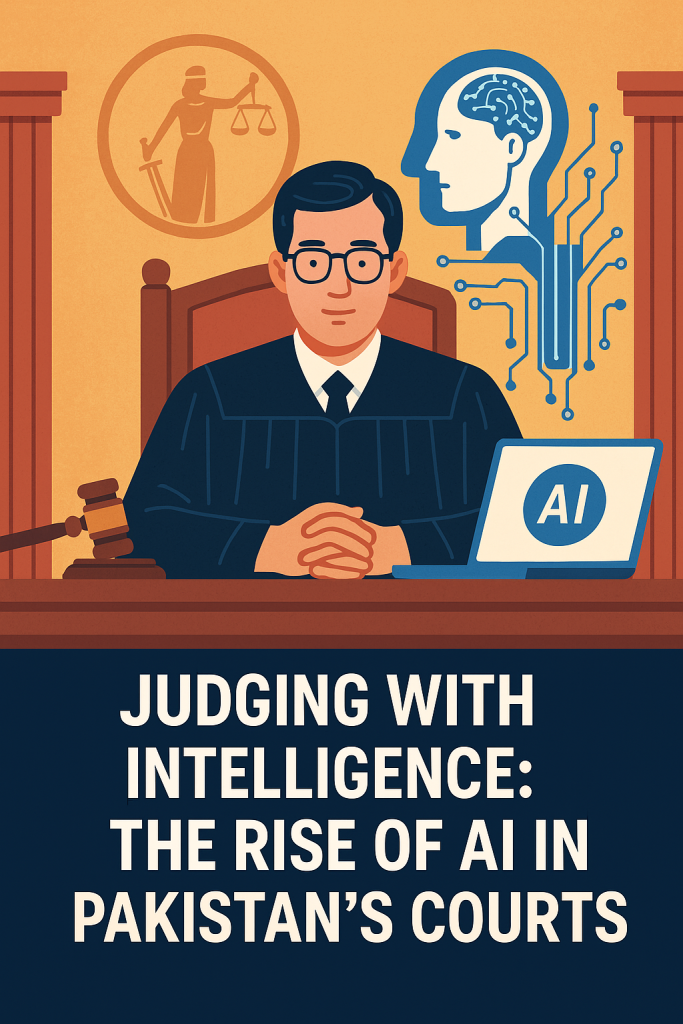
In an unprecedented and visionary move, the Supreme Court of Pakistan has taken a bold step into the future of law. In its judgment dated 13 March 2025 in CPLA No. 1010-L/2022, the Court didn’t just resolve a rent dispute — it opened a new chapter in judicial innovation, advocating for the intelligent, ethical use of Artificial Intelligence (AI) in the administration of justice.
Beyond the Judgment: A Judicial Tech Manifesto.
While the case was rooted in a family rent conflict, its real legacy lies in the Supreme Court’s recognition of how AI can revolutionize Pakistan’s overburdened courts. His lordship Mr. Justice Syed Mansoor Ali Shah, authoring the judgment, highlighted AI as a transformative force for speeding up legal research, improving judicial drafting, managing caseloads, and ensuring greater access to justice.This is the first time Pakistan’s apex court has formally and extensively discussed AI as a judicial tool — not a replacement for judges, but a supplement to accelerate and enhance their work.
The AI Tools That Could Redefine Justice The Court cited a range of AI-powered platforms already in global use:ChatGPT, Copilot & DeepSeek: For drafting and legal summarization.
Judge-GPT: A Pakistan-specific AI tool being used by over 1,500 judges at the district level.
Westlaw AI, Casetext (CARA AI), vLex, CoCounsel: For smart legal research and case law mining.
BriefCatch, WordRake, Clearbrief: For improving the clarity and quality of judicial writing.
Pakistan’s Federal Judicial Academy (FJA) was praised for launching Judge-GPT in collaboration with ETH Zurich — an initiative now positioned as a global benchmark in AI-led legal reform.
AI as a Force for Judicial Efficiency
The Supreme Court emphasized that AI can:
∆ Reduce backlog by speeding up judgment writing and case analysis.
∆ Enhance accuracy in legal research.
∆ Assist with case allocation using bias-free algorithms.
∆ Support consistency by comparing past precedents and flagging contradictions.
But the Court was equally cautious: AI must never replace human reasoning. It must remain “a supportive guide — not a judicial decision-maker.
”Ethical Guardrails: Keeping Justice Human With clarity and foresight, the Court outlined strict ethical boundaries:
Judges must verify all AI-assisted inputs.There must be transparency about the use of AI in rulings. AI-generated hallucinations (false legal citations) must be rigorously avoided.Human empathy, conscience, and discretion must always remain at the heart of adjudication.
The Court invoked Articles 10A and 37(d) of Pakistan’s Constitution — the right to fair and expeditious justice — as the constitutional foundation for adopting AI thoughtfully.
The Global Context:
Pakistan Joins the Conversation.
This judgment places Pakistan alongside jurisdictions like:USA, where the Illinois Supreme Court now has official AI policies.UK & Canada, which have issued ethical guidelines for AI in courts.Singapore & Australia, where court users must disclose AI use.Colombia, China, Slovakia, and others using AI for case classification and allocation.The Road Ahead:
Guidelines, Not Guessworking a groundbreaking recommendation, the Court urged the Law & Justice Commission of Pakistan and the National Judicial (Policy Making) Committee to draft national guidelines on the use of AI in the judiciary. These must preserve judicial independence while embracing efficiency.—
Personal Reflection: Why I Welcome AI in Legal Practice
As a practicing lawyer and a firm believer in innovation, I wholeheartedly welcome this shift toward AI-assisted justice. I personally use multiple AI platforms daily to streamline my workflow, support legal research, and improve access to justice for my clients — especially those from underserved regions or facing cross-border legal challenges.In fact, I have developed my own specialized AI chatbots to help people understand and navigate complex legal issues:
Lawyer Online (POE) –
https://poe.com/Lawyer-Online
Offering general legal help in Pakistan.
Pakistani Criminal Lawyer (ChatGPT) –
https://chatgpt.com/g/g-67e44b0100548191812e577e6fe40c86-pakistani-criminal-lawyer
For guidance on criminal cases.
Pakistani Asylum Lawyer (ChatGPT) –
https://chatgpt.com/g/g-67e53037611c8191b184e1d1bbf2821b-pakistani-asylum-lawyer
Supporting asylum seekers and immigrants.
These tools empower the public with real-time legal knowledge and reflect my commitment to bridging the gap between traditional legal practice and emerging AI technologies.As Pakistan moves forward, I believe that AI — used responsibly — can help lawyers, judges, and litigants alike make our justice system more efficient, inclusive, and fair.—For legal assistance, collaboration, or AI-powered legal services, feel free to connect with me at my office or through my website: www.bestlawyerlahore.com